by Andrew Koch, LPC | contemplativecaregiver.com
I was raised in the flat stretch of land where Indiana cornfields meet soybean rows, where summer smells like diesel, river mud, and hot pavement. Not far from my grandma’s house, a narrow creek ran under a rusted-old bridge. My brothers and I would play down there for endless hours each month chasing chubs and flipping over rocks to find crayfish. That creek, stocked with rainbow trout, was where I first learned the rhythm of flow and the silence of persistence. Under a bridge is where I first learned to listen. Walking against the flow, along banks full of snow is the place where I first felt true, authentic, self-compassion.
Fishing came to me long before I became a counselor, before I even knew what a caregiver was. It was simple back then—bait, cast, wait. But even then, it gave me something steady. In a world that moved so very fast, the water always slowed things down. The ripples and swirls and eddy’s taught me how to read in a way that used no words.
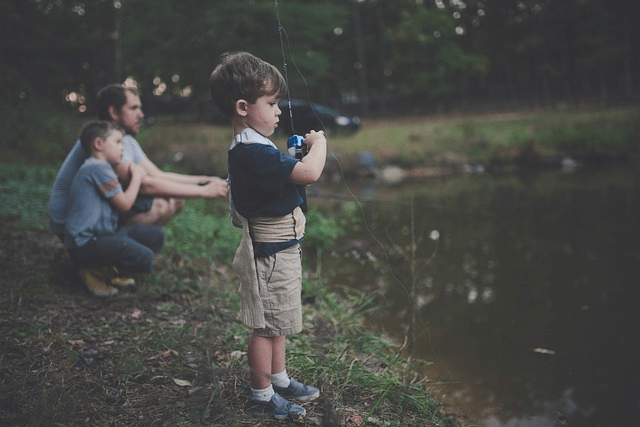
Many, many years later, in 2010, after I started working midnight shifts as a CNA, I came back to fishing in a new way. The job left me physically exhausted and emotionally frayed. After my shift ended at 6:00 a.m., I’d pour a cup of gas station coffee or drink a red bull and drive to the nearest lake or pond or creek before heading home to sleep. For me it wasn’t about catching anything, really. I needed a way to breathe again after holding pressure on someone’s bleeding wound, dressing someone before I thought it decent to awaken them, or helping a confused elder find their room for the third time in a night. Casting into a still lake, often at sunrise became my ritual. In that quiet space between night and day, I could reset my nervous system and return to myself.
Over time, fishing became not just a personal refuge, but a professional calling.
Several years ago, I traveled to Ketchikan, Alaska, and ended up renting a pole from Dolly’s—yes, that Dolly’s Brothel, now a historical museum. I was planning to lead an excursion with a small group of families traveling together, each caring for a loved one with dementia. I supported the families as they stood side by side along the dock, reeling in several types of salmon, laughing, and hugging each other. It wasn’t therapy in the conventional sense, but it was healing.
One man hadn’t spoken clearly in months, due to his advancing dementia, but when his line tugged hard and the fish broke the surface, he shouted, “Got it!” The look on his adult daughter’s face—tears, relief, joy—stayed with me. It reminded me of moments with my own uncle, who also lives with dementia. He rarely speaks now, but he still knows how to fish. When we go out together, we don’t need words. He can’t remember the details of conversations past, but he remembers how to tie a knot and how to watch the line for movement. That kind of embodied memory doesn’t always fade.
I began to ask: What would it look like to offer fishing as therapy—not just as a metaphor, but as a real, accessible mental health practice?

What Is Fishing Therapy?
Fishing therapy is exactly what it sounds like: we fish, and we heal.
It’s not a class. It’s not performance-based. It’s a facilitated experience where we slow down, connect with the land and water, and begin to notice ourselves again. I structure each group around a few core ideas: regulate the nervous system through rhythm and repetition, reconnect through relationship (with nature, others, and self), and release grief, stress, or burnout in a space that doesn’t demand verbal expression.
Fishing works in part because it allows for silence. You don’t have to talk about your pain while you’re fishing. You don’t have to name what’s wrong. But you’re still engaged, still moving. It gives the body something to do while the heart does its own quiet work.
For caregivers, especially those overwhelmed by the weight of daily tasks, medical appointments, and emotional fatigue, this kind of pause can be transformative. That stayed with me. The simple act of holding a rod and watching the water became an act of reclaiming space.

What Caregivers Can Expect
If you’re curious about what a session looks like, here’s a glimpse.
We meet outdoors—currently at Coot Lake in Boulder, Colorado. Sessions are held in the morning to avoid the heat and make the most of the calm atmosphere. No fishing experience is required, and I provide all gear. Accessibility is a priority—seated and standing options are available.
Each session begins with a grounding check-in and basic orientation. But after that, we slow things down. There’s space for conversation, but silence is always respected. I often offer gentle prompts: “What do you notice in your breath?” or “What are you holding in your shoulders right now?”
For some, fishing is a way to let go of what can’t be fixed. For others, it’s a memory—of a father or grandmother who taught them to fish, of a time when they felt more whole. It can be a space of grief, or joy, or both.
Sessions are open to any caregiver—whether you’re caring for a loved one with dementia, working in a care facility, or simply someone holding too much in your daily life.

Why It Matters
Fishing therapy works because it meets people where they are. You don’t have to be strong, or cheerful, or insightful. You just have to show up and cast. The act of being outside, in motion, with a clear purpose and no pressure to perform—this allows something in the nervous system to exhale.
The lakes I fish now aren’t the same as the Indiana creek where I started, but the water still does what it always did: it holds the story. It gives us a place to lay something down.
Whether you grew up fishing or have never held a rod, you are welcome in this work. Caregivers carry so much—sometimes silently, sometimes for years. Fishing therapy gives that burden a place to soften.
Join Us
If you’re ready to try something new—or return to something old—you’re welcome to join us.
To learn more or sign up, visit:
contemplativecaregiver.com/fishing-therapy-group
We’ll meet you by the water. The fish don’t care what you’re carrying. But maybe you’ll leave a little lighter.
 Contemplative Caregiver